
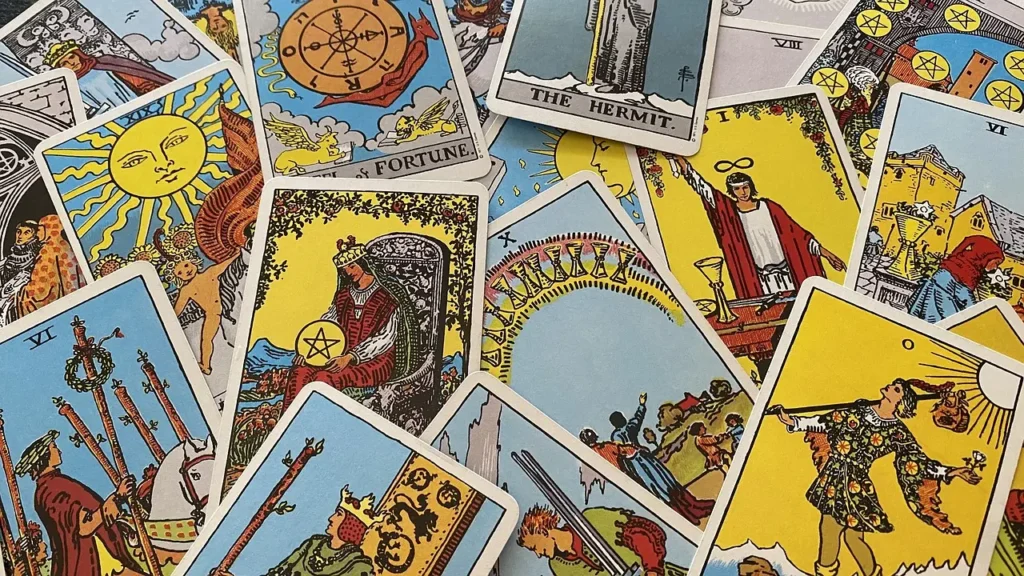




Major Arcana vs Minor Arcana: Meanings, Differences & Reading Practice
If you’ve ever picked up a tarot deck and wondered, “Why are some cards called the Major Arcana while others are called the Minor Arcana?”. Well, you’re not alone. Whether you are a beginner or a professional tarot reader, grasping the difference between Major Arcana and Minor Arcana is foundational. In this friendly, educational guide we’ll discuss: what each set of cards really represents, how they differ, why it matters in a reading, and how you can work with both to deepen your readings.
What are the Major Arcana and Minor Arcana?
- Major Arcana:In a standard 78-card tarot deck you will find 22 cards that are often numbered from 0 to 21 which are called the Major Arcana. The major life events, important turning points in life, archetypal lessons and even spiritual growth are represented by the major arcana cards.
- Minor Arcana:The remaining 56 cards are grouped into four suits (Wands, Cups, Swords, Pentacles). If one wants to see daily reflections, day to day decisions or daily actions in terms of emotional or practicality in our lives then it’s the minor arcana, one would see.
Straightforward Comparison Table
Below is a table summarising key differences between Major Arcana and Minor Arcana, useful whether you are just learning or sharpening your professional practice.
| Feature | Major Arcana | Minor Arcana |
|---|---|---|
| Number of cards | Total 22 cards (numbered 0 to 21) | Total 56 cards ( total 4 suits of 14 cards in each suit.) |
| Themes represented | Major life lessons, spiritual growth, major changes in life | Day to day events, emotional issues, daily choices, practicality |
| Reading significance | Often indicates major turning-points or deep inner transformation | More detail on what is going on day-to-day, the environment, feelings, actions |
| Suits | No suits: each card stands alone as an archetype |
Four suits: Wands (represent fire/action), Cups (represent water/emotion), Swords (represent air/mind), Pentacles (represent earth/material) |
| Best used for | Highlighting where you are on your soul-journey, long-term themes | Contextualising how you’re navigating your day-to-day, what you can act on now |
| How to interpret | Slower, deeper, often requires reflection | Faster, often more immediate meaning, more relational, more “what’s happening now” |
| Typical message | “This is what your life is learning.” | “This is what is happening around you / what you can do today.” |
| When many appear in a reading | Indicates some major turn is going to happen in your life | Indicates many things happening, or many variables in play, the suits helps in intepreting |
Why this Difference Matters for You as a Reader
Understanding the difference between Major Arcana and Minor Arcana is more than academic, it changes how you read, interpret, and convey messages.
For Beginners
- When you pull mostly Major Arcana cards, you know: “Ah, this reading is pointing to a soul-lesson or big life chapter.”
- If mostly Minor Arcana show up, the reading is likely to be more about “what you can do today / this week / in your environment.”
- This helps you not over-react when you see a ‘big’ card, you recognise it as part of a larger theme rather than immediate crisis.
For Professionals
- You can guide your client by differentiating: “Here’s the big picture (Major Arcana) and here’s what you can tackle now (Minor Arcana).”
- You can calibrate the reading: If both Major and Minor cards are heavy, the client may be entering a major life phase with many practical issues.
- You can plan follow-up: If Major indicates transformation, then Minor cards show how that transformation will play out.
For Both
- It enriches your language. Instead of simply naming a card, you can say: “This is a Major Arcana card showing a shift in your soul’s journey. The surrounding Minor Arcana tell us how that shift will express itself.”
- It strengthens your credibility, you demonstrate that you understand structure of the deck, not just memorised meanings.
How They Work Together in a Reading
The difference between Major Arcana and Minor Arcana does not mean you use one and ignore the other. Strong readings integrate both.
- The Major Arcana sets the frame: “Big theme: transformation, or relationship shift, or new chapter.”
- The Minor Arcana supplies the details: “How is this manifesting now? What practical steps or feelings are at play?”
- When you pull a spread that mixes both, you get a richer, layered story: spiritual + material, soul + everyday.
Example: Suppose you ask: “What’s coming for my career?”
- If you pull the Major Arcana card The Chariot, you know this is a major advancement or direction shift.
- Then you pull Minor cards like Six of Pentacles and Nine of Wands: you interpret that as “You will move ahead (Chariot), you’ll receive support or give support (Six of Pentacles), but you’ll need to persevere or perhaps defend your position (Nine of Wands).”
In this way both sets come together to give a full message.
Practical Tips for Working with Each
Here are actionable suggestions for you, whether you’re brand-new to tarot or refining your art.
Working with Major Arcana
- Meditate on one major card each week to absorb its theme (e.g., draw The Hermit and spend a week reflecting on solitude and inner guidance).
- When performing readings for clients, if three or more Major Arcana come up, pause and say: “This is a big theme, we might be looking at a chapter, not just a day.”
- Use Major cards as “significators” or anchors in spreads (especially for self-readings). As explained above, pull one Major arcana card and then to simplify and understand it better, pull out minor arcana cards.
Working with Minor Arcana
- Learn the four suits and elements: Wands = fire/action, Cups = water/emotion, Swords = air/thoughts, Pentacles = earth/material.
- Notice when you get a “run” of one suit, that often highlights that area of life is very active. For eg, if you see more of cups means you know its about something related to emotions.
- Use Minor sets to assess “what can I do now?” and “what is happening around me?” rather than only “what is my soul’s lesson?”
Common Mistakes & How to Avoid Them
Even experienced readers sometimes mis-interpret because they ignore the difference between Major Arcana and Minor Arcana. Here are some pitfalls:
-
Mistake: Treating all cards as equal in weight.
Fix: Recognise Major cards carry heavier themes and require longer term reflection; Minor cards often call for action. -
Mistake: Ignoring Minor cards because “Major are more important.”
Fix: No, always remember, Minor cards show how the “big theme” is playing out practically. They’re vital. -
Mistake: Overreacting to a Major card as if it’s doom.
Fix: A Major card means attention required, not necessarily catastrophe. Use supportive language. -
Mistake: Reading Minor cards as if they were Major (assigning grand themes to everyday cards).
Fix: See if the context calls for a major or minor lens. Is the question long-term or short-term?
A Quick Reference Table for Readers
Here’s a handy table for you to print or keep nearby when reading. It summarises how to think about each set:
| Question to ask | Major Arcana answer | Minor Arcana answer |
|---|---|---|
| “What is the big theme here?” | Major card appears = yes, big theme | Minor appears = maybe day-to-day manifestation |
| “What can the client act on now?” | Major gives overarching direction | Minor gives specific step or situation |
| “Is this reading about a life-chapter or a moment?” | Many Majors = chapter | Many Minors = moment or phase |
| “Is the issue spiritual or material?” | Major often spiritual/soul-growth | Minor often material/practical (though overlaps exist) |
Real-Life Examples
-
Example 1: You draw The Lovers (Major Arcana) + Page of Cups + Two of Wands.
Interpretation: A major relationship choice (The Lovers) is happening. You’re entering a new emotional phase (Page of Cups) and you’re considering your options (Two of Wands). -
Example 2: You draw Five of Swords (Minor Arcana) + Seven of Pentacles (Minor Arcana).
Interpretation: There is conflict or challenge now (Five of Swords), and you’re waiting to see results of your effort (Seven of Pentacles). Here the Major arcana may not show up, meaning the reading is about current conditions rather than life path. -
Example 3: You draw Death (Major Arcana) + Ten of Wands (Minor Arcana) + King of Pentacles (Minor Arcana).
Interpretation: A major transformation is underway (Death). You’ve been carrying a heavy burden (Ten of Wands) and your next step may involve mastery or taking full charge of your material world (King of Pentacles).
Final Words
Understanding the difference between Major Arcana and Minor Arcana empowers you. It stops you from mis-reading when you pull a card and teaches you how to interpret your spreads with more depth and clarity. Whether you are a beginner learning the deck or a professional guiding others, knowing how the Major and Minor Arcana work, both separately and together, elevates your readings.
Remember: the Major Arcana speak of why things are happening (the soul journey, the big themes) and the Minor Arcana show how things are happening (the experience, the detail, the action). Use them both, link them in story, and your readings will become richer.
If you enjoyed this guide and want to dive deeper, feel free to explore our other blog posts on Tarot learning. Happy reading, and may your next spread unfold with clarity and purpose.
Frequently Asked Questions (FAQs)
Q1: Can I read tarot using only Major Arcana cards?
A: Yes, some readers work with only the Major Arcana for “big picture” or spiritual level readings. But you’ll miss the everyday details that Minor Arcana provide. The 22 Major cards give strong archetypal messages, but for many readings you’ll benefit from the full 78-card deck.
Q2: If lots of Minor Arcana show up, does that mean nothing major is happening?
A: Not necessarily. Lots of Minor cards may mean the reading is focused on practical issues, steps, or immediate concerns. It doesn’t mean change won’t happen but the emphasis is more on the “how” and “what” rather than the “why”.
Q3: Should I learn Major Arcana first or Minor Arcana first?
A: Usually its always better to start with Major Arcana’s first as one can do readings using just the major arcana cards. When you become comfortable, start with Minor Arcana cards to know a better picture of what actually is happening.
Q4: How do I know which suit a Minor Arcana card belongs to and what it means?
A: The suit gives you the element and area of life: Wands (fire/action), Cups (water/emotion), Swords (air/thoughts), Pentacles (earth/material). The court card represents human characters, the stages in life.
Q5: If a Major Arcana appears reversed (upsidedown), does that change its importance?
A: Reversals (if you use them) may show blocked energy, delayed themes, or internalised lessons. But the fact that it’s a Major card still means the lesson is significant, you’ll still want to treat it as a “big theme” and then look at how the reversal modifies it.