
Shurpanakha in Ramayana: The Story That Changed Destiny
Published by: Forge Your Best Self | Date:
Introduction: The Forgotten Character Who Changed History
When we think of the Ramayana, names like Lord Ram, Sita, Ravan, Hanuman, and Lakshman instantly come to mind. Yet, there is one character who, though often overshadowed, played a pivotal role in shaping the destiny of the epic itself: Shurpanakha.
Her story is not just about a woman’s desire being rejected. It is about how one encounter in Panchavati triggered a chain of events leading to the abduction of Sita, the Vanara alliance, the bridge to Lanka, and finally, the downfall of Ravan.
Who Was Shurpanakha in Ramayana?
Shurpanakha, whose name literally means “long-nailed”, was the sister of Ravan, the mighty king of Lanka. She was born to Rishi Vishrava and Kaikesi.
- She belonged to a powerful family: Ravan, Kumbhakarna, and Vibhishana were her brothers.
- Unlike her brothers, Shurpanakha is remembered mainly for her role in instigating the war between Ram and Ravan.
Despite her rakshasi background, she was described as beautiful and charming in her natural form, but also capable of taking fearsome, demonic appearances.
The Panchavati Encounter: Shurpanakha Meets Ram
While Ram, Sita, and Lakshman were living in exile at Panchavati, Shurpanakha wandered into the forest and was captivated by Ram’s divine beauty.
- She approached Ram and expressed her desire to marry him.
- Ram, being committed to Sita, gently declined and directed her towards Lakshman.
- Lakshman, playfully, also rejected her advances.
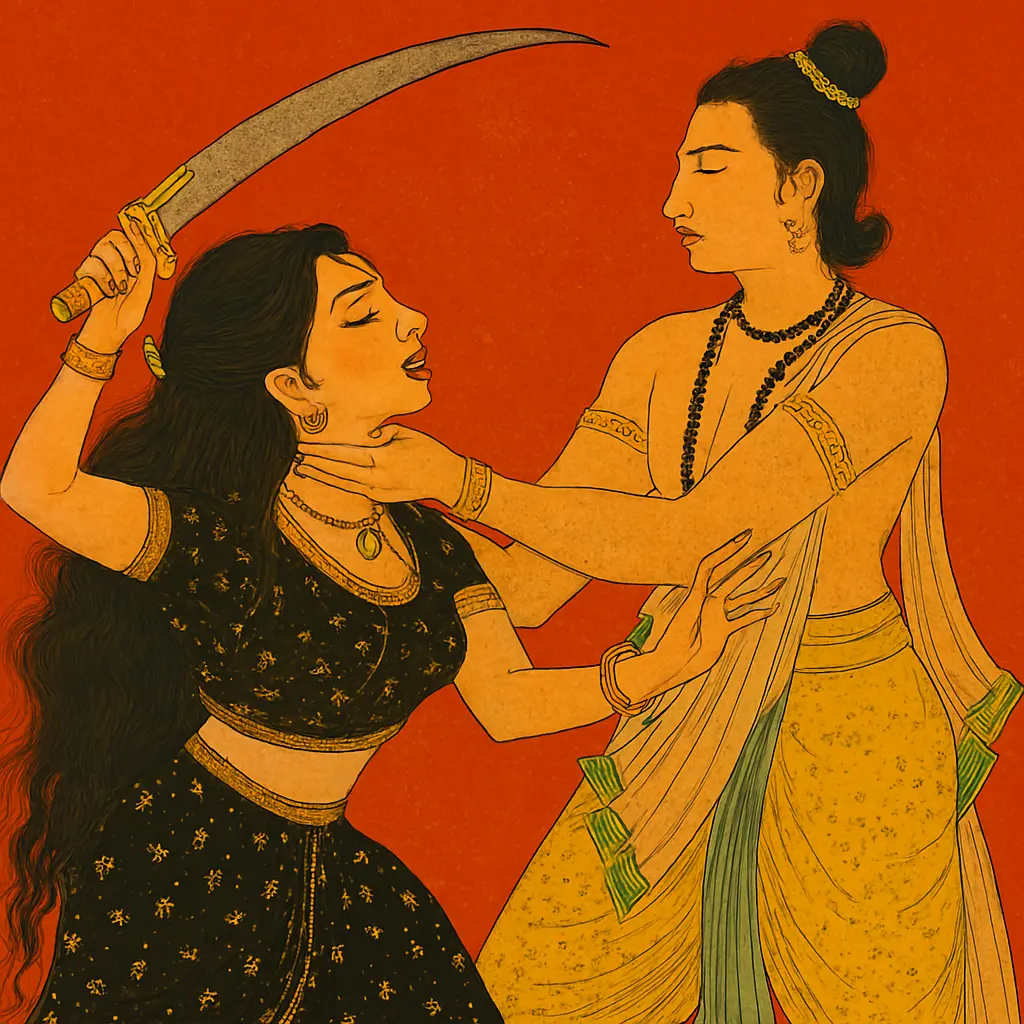
Humiliated, Shurpanakha attacked Sita out of jealousy. Lakshman intervened and cut off her nose and ears—marking the catalyst of destiny.
Why Did Lakshman Cut Shurpanakha’s Nose?
The act was both symbolic and practical:
- In Vedic culture, the nose represented honor and pride. Cutting it off meant stripping her of dignity.
- It was a punishment for crossing boundaries and attacking Sita.
- Symbolically, it represented the victory of dharma over uncontrolled desire and adharma.
Shurpanakha’s Role in Destiny: The Domino Effect
- She ran to Ravan for revenge, describing Sita’s beauty and provoking him.
- Ravan abducted Sita, setting in motion the great war.
- The Vanara alliance was formed through Ram’s friendship with Hanuman and Sugriva.
- The epic war in Lanka led to Ravan’s downfall and cosmic balance.
Thus, Shurpanakha’s rejection and humiliation became the hidden trigger of Ramayana’s climax.
Symbolism of Shurpanakha in Ramayana
- Uncontrolled desire leads to destruction.
- Every action has consequences.
- The feminine power of choice—Shurpanakha expressed desire boldly.
- Dharma vs. Adharma—her story shows the need for firm boundaries.
Shurpanakha in Different Versions of Ramayana
- Valmiki Ramayana: Focuses on her as the turning point character.
- Kamba Ramayanam (Tamil): Adds more detail about her emotions and humiliation.
- South East Asian Ramayanas: Sometimes depict her sympathetically as a woman wronged.
Shurpanakha’s Life After Ramayana
- She lived in Lanka but withdrew from palace politics.
- Some legends say she wandered the forests, cursed by destiny.
- In certain retellings, she gained spiritual realization later in life.
Conclusion: The Story That Changed Destiny
Shurpanakha’s story is not just about a woman whose nose was cut off. It is about how a single incident reshaped history, shifted destinies, and fulfilled cosmic balance.
She reminds us that even the smallest moments—an insult, a rejection, a choice—can create ripples that affect generations. Just as her encounter in Panchavati set the stage for the great war, our own actions have the power to shape destiny.